-
Tel : +86-20-82455585
-
Email : info@mgaerosolcan.com

Tel : +86-20-82455585
Email : info@mgaerosolcan.com
——China Customs' "Golden Key" special operation continues to intensify, and misdeclaration may result in detained shipments and heavy penalties.
For overseas buyers sourcing metal packaging products (aluminum cans, tin cans, etc.) from China, an undeniable trend is emerging: supply chain stability is becoming a more critical cost factor than unit price itself.
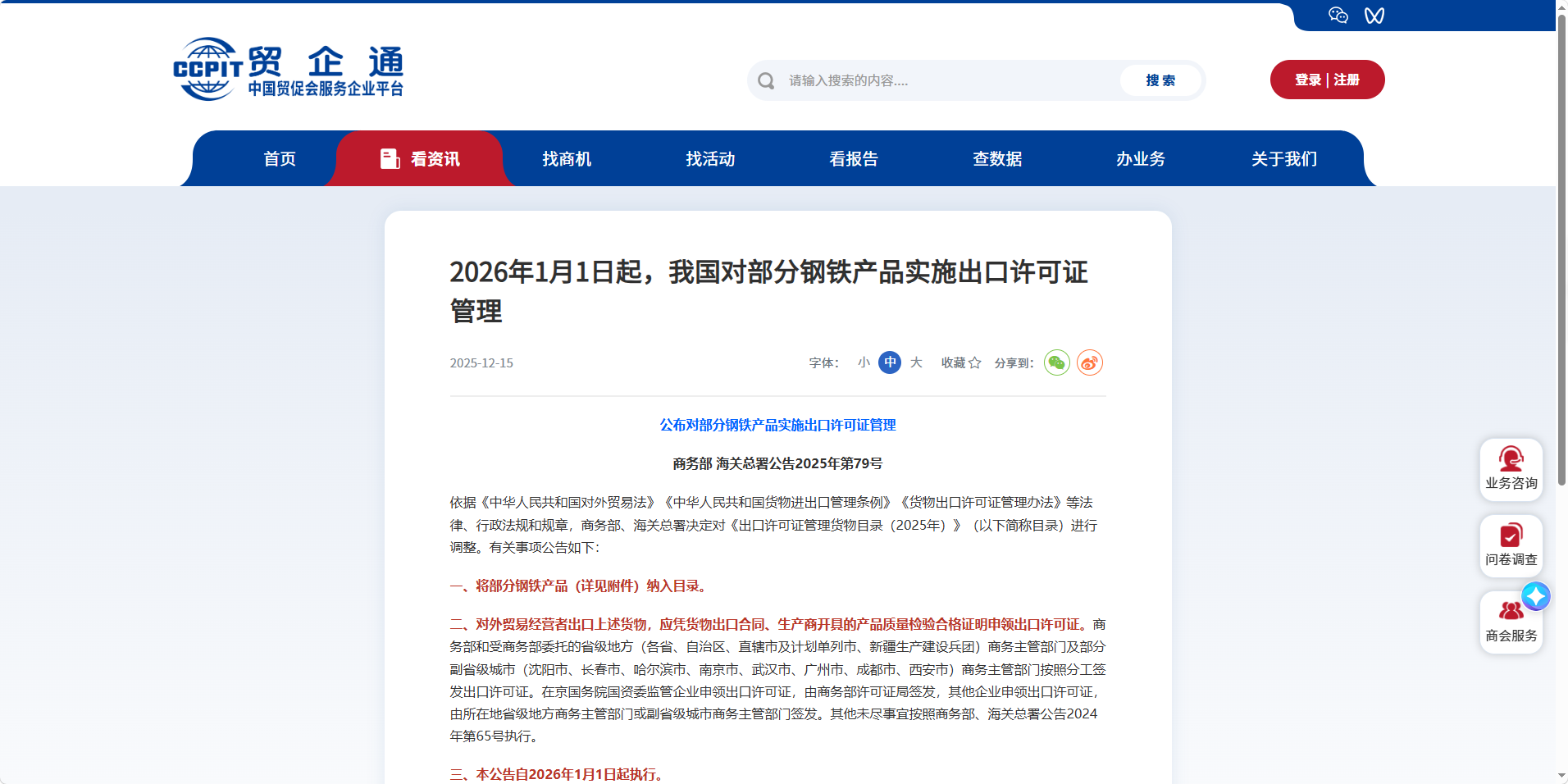
(According to a report from an authoritative Chinese website)
1.Stronger Oversight: From Special Operations to License Management – Comprehensive Inspections with No Blind Spots
According to an official announcement by the General Administration of Customs (GAC), in 2025, nationwide customs authorities launched a special inspection operation code-named "Golden Key 2025." A large number of trade activities involving metal products such as steel and aluminum alloys have been placed under key scrutiny, and the intensity of this operation will continue to strengthen in 2026.
Meanwhile, as stipulated in the Ministry of Commerce (MOFCOM) and GAC Joint Announcement No. 79 of 2025, certain steel and aluminum alloy products have been formally brought under export license administration effective January 1, 2026. This means that on-site customs inspections have shifted from previous random spot checks to targeted, focused verification of specific HS codes and their related products.
Together, these two developments send a clear signal: compliance reviews for metal product exports have been elevated to a systematic customs supervision priority. Any mentality of leaving things to chance may lead to serious consequences.
2. Inspection Focus: Why Your Aluminum and Tin Cans May Be Held Up at Customs
Despite the fact that finished aluminum and tin cans intended for packaging are not controlled items per se, they may still become subjects of inspection under the current regulatory environment due to the following two core issues:
1. Composition Screening
Customs authorities are becoming increasingly stringent in testing the composition of metal products. Even when standard-grade aluminum alloys or steel are used, if trace amounts of controlled metals have been inadvertently mixed in or added during production and the supplier has failed to conduct proper compliance testing, any such substances detected by customs laboratories will render the export non-compliant.
2. Accuracy of HS Code Declaration
Since 2024, a growing number of companies have resorted to false declarations in an attempt to fraudulently claim high export tax rebates or evade license management. In response, the customs risk profiling system has flagged HS code misdeclaration as a high-risk trigger and significantly increased the sampling rate. Even for legitimate exports of metal cans, if the declared code is vague or ambiguous, shipments are highly likely to be flagged by the system and referred for manual inspection.
Once a misdeclaration or regulatory evasion is confirmed, the risks you face include but are not limited to:
Detention, return, or confiscation of goods
Credit rating downgrade
Consequential losses for the buyer (e.g., customs clearance at the destination port may be disrupted due to a lack of compliant documentation, and the FTA zero-tariff benefits you anticipated could be rendered null and void)
3. Our Solution: Superior Products + Minimal Risk
We fully understand that in the metal packaging industry, we cannot promise the lowest prices. However, we are industry-leading when it comes to risk management. For you, a successful, delay-free delivery is far more valuable than saving a few cents on paper.
To that end, we have built an export compliance internal control system that far exceeds the industry average, including:
Dual HS Code Review
For every order, the HS code is cross-verified by both the business department and the customs affairs team, ensuring that finished metal can bodies strictly use the correct finished product codes. This fundamentally eliminates the inspection risk arising from ambiguous code classification.
Composition Pre-Screening and Laboratory Endorsement
For customized or specially coated packaging containers, we proactively send samples to authoritative third-party bodies to test for any controlled elements, ensuring that shipments can be cleared immediately during random customs inspections.
Seamless Management of Licenses and Certificates of Origin
We dynamically track adjustments to the export license administration catalog. Should any ancillary products you purchase become subject to licensing requirements, we will notify you in advance and assist with the application. Under free trade agreements such as RCEP, we ensure that the certificates of origin we provide are fully compliant and accurate, safeguarding your tariff treatment in the destination country.
Dynamic Policy Alerts and Proactive Response
We continuously track the latest inspection priorities of special operations such as "Golden Key," and proactively adjust our contract declaration strategies with you ahead of policy change windows, ensuring you are never exposed to policy risks.
so
The current export regulatory environment has made it clear: a low price no longer equates to low overall cost. We recommend that all overseas buyers explicitly ask the following questions when evaluating suppliers:
Is the supplier aware of and compliant with the latest export license administration requirements?
Can the supplier provide a written HS code classification rationale and a composition compliance statement for the specific products you are sourcing?
How does the supplier's customs team handle the risk of inspection-related delays, and do they have contingency plans in place?
We welcome you to test us with these questions, because these are the very standards by which we have built our business.
References:
GAC Notice on the "Golden Key 2025" Special Inspection Operation
MOFCOM and GAC Announcement No. 79 of 2025 (Announcement on the Implementation of Export License Administration on Certain Steel Products)
 Guangzhou MIJIA Aerosol Can
Tel : +86-20-82455585
Email : info@mgaerosolcan.com
Whatsapp : +86 13632189028
Address : NO.11, XINGZHENG ROAD, SHANJIAO COUNTY, ZHUCUN STREET,ZENGCHENG DISTRICT, GUANGZHOU, GUANGDONG, CHINA